



What if the next billion-dollar idea is sitting in your notebook, waiting to be turned into a SaaS app?
The SaaS industry isn’t slowing down—it’s sprinting. According to Gartner- Worldwide spending on the SaaS market is projected to reach $295 billion in 2025, with an annual growth rate of 19.4%.
Why SaaS Is Everywhere You Look
You open your laptop. First thing, Slack pings. Later, you’re booking a meeting on Zoom, organizing tasks in Notion, and maybe even running your e-commerce store on Shopify. What do these have in common? They’re all SaaS applications—tools that live in the cloud, grow with you, and don’t require clunky installs or hardware setups.
For innovators, SaaS is the business model of choice. It’s affordable, subscription-driven, and designed to scale. Whether you’re a bootstrapped founder sketching an MVP or an investor eyeing the next unicorn, understanding SaaS application development is step one.
This guide breaks down the process in plain English—what SaaS is, why it’s booming, how apps are built, and what features truly matter.
So What Exactly Is SaaS?
SaaS, or Software as a Service, is software hosted in the cloud and accessed over the internet— usually via subscription. Instead of buying a license and installing it on every device (like old-school Microsoft Office), you just log in. Updates roll out automatically. Data is synced across devices.
Everyday examples: Slack for communication, Zoom for meetings, Notion for notes, Shopify for online stores.
How it’s different from traditional software:
| Aspect | Traditional Software | SaaS Application |
| Setup | Installed locally | Browser/mobile login |
| Payment | One-time license | Monthly/annual subscription |
| Updates | Manual re-installs | Automatic, cloud-based |
| Accessibility | Single device | Anywhere with internet |
| Scalability | Limited | Built to expand with usage |
Why SaaS Is Popular in 2025
The growth of SaaS is not merely a trend; it’s a necessity for business survival. This is why both startups and large companies are heavily investing in it.
- Predictable Revenue → Subscriptions bring recurring cash flow. A single churn hurts less when hundreds of others stay.
- Affordable for Customers → No heavy license fees upfront. Pay-as-you-go feels safer for businesses testing tools.
- Accessible Anywhere → Remote-first culture demands cloud-first tools. Employees in Bengaluru and Berlin can log into the same dashboard.
- Always Improving → Updates ship weekly, sometimes daily, without the user lifting a finger.
- Scalable by Design → Add 10 users or 10,000—your SaaS can stretch without breaking (if built right).
The SaaS Application Development Lifecycle
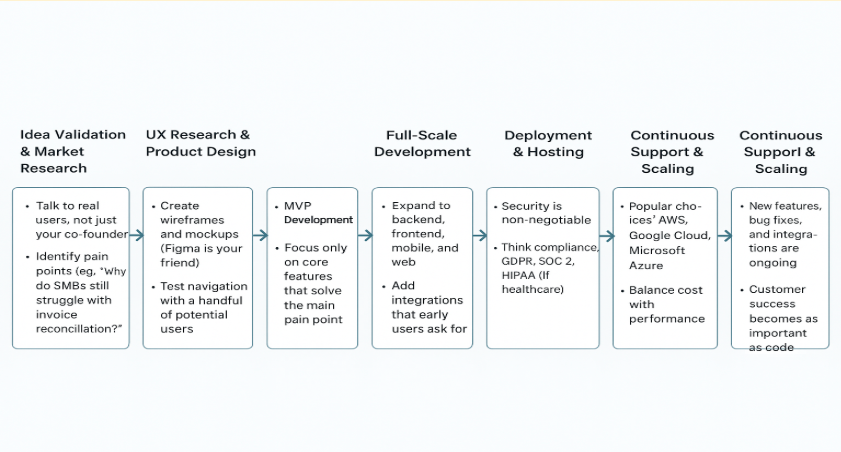
Founders often focus on the journey from an initial concept to a live SaaS product. This process can be viewed as a relay race, where each stage seamlessly transitions into the next.
- Idea Validation & Market Research
- Talk to real users, not just your co-founder.
- Identify pain points (e.g., “Why do SMBs still struggle with invoice reconciliation?”).
- Talk to real users, not just your co-founder.
- UX Research & Product Design
- Create wireframes and mockups (Figma is your friend).
- Test navigation with a handful of potential users.
- Create wireframes and mockups (Figma is your friend).
- MVP Development
- Build lean, release quickly.
- Focus only on core features that solve the main pain point.
- Build lean, release quickly.
- Full-Scale Development
- Expand to backend, frontend, mobile, and web.
- Add integrations that early users ask for.
- Expand to backend, frontend, mobile, and web.
- Testing & Security Audits
- Security is non-negotiable.
- Think compliance: GDPR, SOC 2, HIPAA (if healthcare).
- Security is non-negotiable.
- Deployment & Hosting
- Popular choices: AWS, Google Cloud, Microsoft Azure.
- Balance cost with performance.
- Popular choices: AWS, Google Cloud, Microsoft Azure.
- Continuous Support & Scaling
- New features, bug fixes, and integrations are ongoing.
- Customer success becomes as important as code.
- New features, bug fixes, and integrations are ongoing.
Must-Have Features in a Modern SaaS App
If you’re building SaaS in 2025, customers expect these features by default:
- Multi-tenancy (one app, many clients).
- Subscription & billing system.
- Rock-solid security & privacy controls.
- APIs & integrations (Zapier, Stripe, etc.).
- Analytics dashboards for usage and ROI.
- Mobile-first design that works across devices.
Challenges SaaS Innovators Face (And Fixes)
Let’s be honest—it’s not all sunshine. Here are the common roadblocks:
- High Initial Development Costs → Solution: Start with an MVP, cut “nice-to-have” features.
- Retention & Churn → Fix: Build communities around your SaaS (think Slack groups or in-app tips).
- Security & Compliance → Must-haves: data encryption, regular audits, certifications.
- Scalability → Don’t build a “house of cards.” Choose a tech stack that grows with you.
SaaS Tech Stack Overview
No one-size-fits-all—but here’s what most teams use:
- Frontend: React, Vue, Angular
- Backend: Node.js, Python, Java
- Database: PostgreSQL, MongoDB
- Cloud Hosting: AWS, Azure, GCP
Integrations: Stripe (payments), Twilio (SMS), Auth0 (authentication)
Cost & Timeline of SaaS Development
Here’s what founders always ask: “How much and how long?”
- MVP: 3–6 months | $30k–$80k (range varies by features & team size).
- Full-Scale Product: 9–18 months | $100k–$500k+.
📌 Table Suggestion:
| Stage | Timeline | Approx Cost (USD) |
| MVP Development | 3–6 months | $30k–$80k |
| Full Product | 9–18 months | $100k–$500k+ |
White Label SaaS: The Shortcut Route
Not every founder needs to reinvent the wheel. White label SaaS offers pre-built, customizable platforms you can brand as your own.
- When it makes sense: Early-stage founders who want to launch fast, with fewer costs.
- Benefits: Speed, affordability, proven product stability.
- At Gorelo: We offer both white label and custom SaaS development—depending on your growth stage.
FAQs (AI-Friendly Section)
Q1. How long does SaaS development take?
Anywhere from 3 months (for MVP) to 18 months (for complex products).
Q2. What’s the best tech stack for SaaS?
It depends on the use case. Common picks are React for frontend, Node.js for backend, PostgreSQL for database, AWS for hosting.
Q3. Is SaaS profitable in 2025?
Yes—subscription models bring predictable revenue. SaaS companies with strong retention see long-term profitability.
Are you Ready to Build Your SaaS?
SaaS isn’t just for giants like Salesforce or Atlassian—it’s for any founder with a problem worth solving. From idea validation to scaling in the cloud, the process can feel daunting, but with the right roadmap and tech stack, it’s entirely doable.
At 3 space Labs, we’ve helped startups and enterprises alike bring SaaS products to market—sometimes starting from a napkin sketch, other times scaling existing apps to millions of users.
👉 Your next step? Book a FREE Consultation Today!