



“Ever noticed how your favorite coffee shop has a ‘house blend’ that tastes suspiciously like the one sold at the supermarket? What if I told you software works the same way?”
“According to One Graph, 62% of businesses reported improved customer engagement after implementing ready-made apps.” Businesses are no longer just buying products — they are rebranding ready-made software to save years of work.
Rebranding and reselling are timeless strategies that have gained even greater importance in 2025. In today’s landscape, success hinges on speed to market, cost control, and leveraging advanced technologies such as Web3 and SaaS.
Let’s unpack what white label solutions really are, how they work, the industries embracing them, and why your business should care especially if you’re tired of burning time and budget reinventing the wheel.
So, What Exactly Are White Label Solutions?
At its simplest, a white label solution is a ready-made product or service created by one company but rebranded and sold by another as if it were their own.
Think of it like supermarket products: the same olive oil might sit on the shelf under five different brands, but the core product was manufactured by the same provider. In software, the same principle applies — businesses can rebrand ready-built platforms (like CRM tools, mobile apps, or NFT marketplaces) and call them their own.
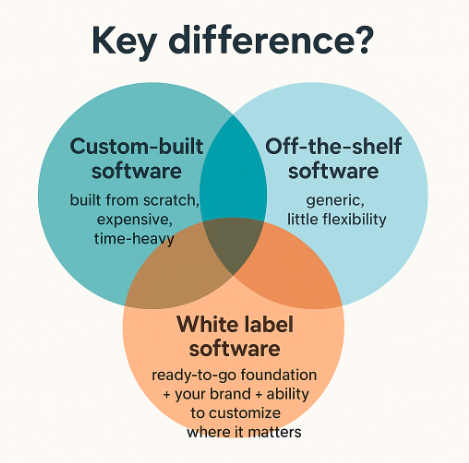
👉 Key difference?
- Custom-built software → built from scratch, expensive, time-heavy.
- Off-the-shelf software → generic, little flexibility.
- White label software → ready-to-go foundation + your brand + ability to customize where it matters.
Types of White Label Solutions in Software
White labeling isn’t one-size-fits-all. In fact, it’s sprawling across industries with very specific applications:
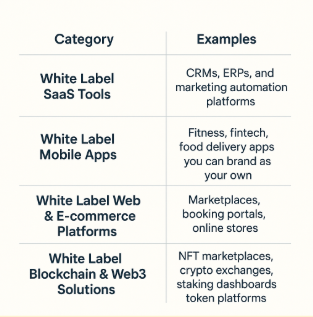
- White Label SaaS Tools – CRMs, ERPs, and marketing automation platforms.
- White Label Mobile Apps – Fitness, fintech, food delivery apps you can brand as your own.
- White Label Web & E-commerce Platforms – Marketplaces, booking portals, online stores.
- White Label Blockchain & Web3 Solutions – NFT marketplaces, crypto exchanges, staking dashboards, token platforms
Why Businesses Are Adopting White Label Solutions in 2025
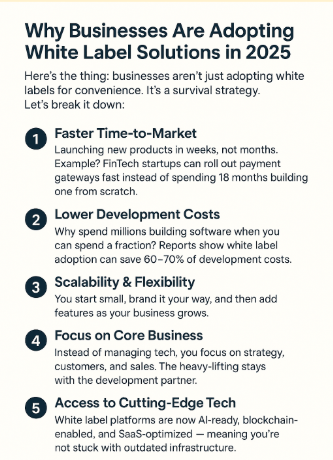
Here’s the thing: businesses aren’t just adopting white labels for convenience. It’s a survival strategy. Let’s break it down:
1. Faster Time-to-Market
Launching new products in weeks, not months. Example? FinTech startups can roll out payment gateways fast instead of spending 18 months building one from scratch.
2. Lower Development Costs
Why spend millions building software when you can spend a fraction? Reports show white label adoption can save 60–70% of development costs.
3. Scalability & Flexibility
You start small, brand it your way, and then add features as your business grows.
4. Focus on Core Business
Instead of managing tech, you focus on strategy, customers, and sales. The heavy-lifting stays with the development partner.
5. Access to Cutting-Edge Tech
White label platforms are now AI-ready, blockchain-enabled, and SaaS-optimized — meaning you’re not stuck with outdated infrastructure.
Industries Leading the White Label Adoption
Here’s where the action is heating up in 2025:
| Industry | Example White Label Solution | Why It Works |
| FinTech & Banking | Payment gateways, wallets, trading platforms | Trust + compliance ready |
| E-commerce | Marketplaces, delivery apps | Speed + scalability |
| SaaS Startups | CRMs, ERPs, productivity tools | Low-cost growth |
| Web3 & Blockchain | NFT, staking, token dashboards | High-demand + faster launches |
| EdTech/HealthTech | Learning platforms, telemedicine apps | User trust + accessibility |
White Label vs. Custom Software: Which Makes Sense?
Let’s be blunt — neither is always better. It depends.
- White Label = Speed, affordability, ready-to-use foundation.
- Custom = Control, deep customization, uniqueness.
- Hybrid = Best of both worlds (white label core + custom add-ons).
The Challenges No One Talks About
It’s not all roses. Here are some challenges you should be aware of:
- Limited deep customization.
- Relying on vendors for updates.
- Brand differentiation hurdles.
- Security/compliance concerns.
💡 But here’s where 3 Space Labs steps in: by offering audited, tested, and customizable white label blockchain and SaaS solutions, we help businesses avoid these pitfalls.
Choosing the Right White Label Development Partner
Checklist before signing with anyone:
- Proven expertise in your industry (SaaS, Web3, fintech).
- Ability to customize and scale.
- Strong security and compliance.
- Ongoing support, not just delivery.
This is where 3 Space Labs comes in: whether you’re launching an NFT marketplace, SaaS platform, or blockchain staking dashboard — we’ve already built it, tested it, and know how to customize it for you.
The Future of White Label Solutions in 2025 & Beyond
Expect more AI-powered white label apps, tighter API ecosystems, and bigger Web3 adoption. Companies that can brand fast, scale faster, and stay flexible will dominate.
Conclusion
So, back to that coffee analogy. Whether it’s your favorite “house blend” or your company’s new SaaS platform, the truth is the same: rebranding ready-made products isn’t cutting corners, it’s smart business.
Whether you’re building in SaaS or Web3 and don’t want to waste months reinventing the wheel, 3 Space Labs has you covered.
Launch your platform faster, save money, and still keep it yours.
👉 Ready to test-drive white label solutions?
Book a FREE Consultation Today!